
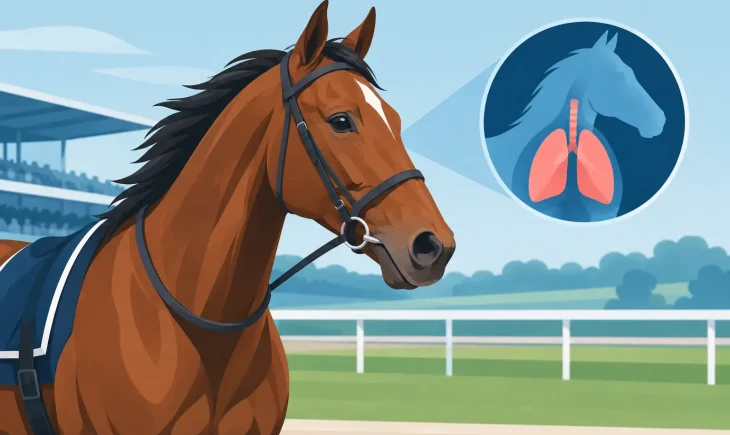
A horse can come back from a hard work looking bright, finish its feed, and still have blood in its lower airways. That is why EIPH symptoms in racehorses deserve attention even when there is no obvious blood at the nostrils. Exercise-induced pulmonary hemorrhage can reduce airflow, affect recovery, and take a costly edge off a horse that otherwise appears fit to run.
What EIPH symptoms in racehorses can look like
EIPH occurs when intense exertion causes bleeding into the airways. It is most associated with high-speed racing, but the amount of bleeding varies widely. Some horses show clear signs after a race or fast breeze. Many show none that can be seen from the shedrow.
Visible blood is a serious but uncommon sign
Epistaxis, or blood coming from one or both nostrils after exercise, is the sign most people associate with a bleeder. It needs immediate veterinary attention and should never be dismissed as a minor post-race issue. However, visible nasal bleeding represents only a small proportion of horses with EIPH.
A horse may have blood deeper in the trachea or bronchi without a drop appearing at the nostrils. Waiting for epistaxis before investigating can mean missing mild or moderate EIPH that is already affecting performance.
Subtle changes often show up first
The less obvious signs are often the ones trainers and riders notice first. A racehorse may tire earlier than expected, fail to finish with its usual determination, or take longer to recover after a gallop. Some horses cough once or repeatedly after work, swallow more than usual, or make an abnormal respiratory noise.
Poor performance alone does not prove EIPH. It can also reflect pain, poor fitness, heat stress, upper airway obstruction, lower airway inflammation, infection, ulcers, or a training issue. The useful question is whether the change is repeatable and linked to hard exertion.
Performance clues worth tracking
A single flat performance can happen for dozens of reasons. A pattern is more useful. Keep clear notes on the horse’s speed work, recovery rate, coughs, respiratory noise, appetite, behavior, and results. Compare each horse with its own normal baseline rather than another horse in the barn.
Possible warning signs include a horse that fades late despite normal early pace, needs longer to return to normal breathing, resists finishing work, or returns from the track with a wet cough. A reduced desire to train can matter as much as a dramatic respiratory sign. High-level horses frequently mask discomfort until their performance drops.
Blood-stained saliva, froth around the mouth, or dark nasal discharge after work should be reported to the veterinarian. These signs are not always caused by EIPH, but they justify prompt assessment.
Why bleeding can be easy to miss
EIPH is not simply a horse “bleeding from the nose.” During maximal exercise, pressures within the tiny blood vessels of the lungs rise sharply. If those vessels leak or rupture, blood enters the airways. It may remain below the level where it becomes visible externally.
A horse can also clear small amounts of blood quickly. By the time it is cooled out and examined, the evidence may be gone from view. This is why an apparently normal horse after racing cannot be cleared based on appearance alone.
The risk tends to increase with intense speed, repeated hard efforts, age, and a history of prior episodes. Dusty environments, airway inflammation, and respiratory infections may add stress to an already challenged respiratory system. There is no single cause in every horse, and there is no one-size-fits-all fix.
When to call the veterinarian
Call the veterinarian promptly if blood is seen at the nostrils, the horse has marked breathing difficulty, collapses, appears distressed, or has a persistent cough following exercise. Do not ship, breeze, or race a horse showing those signs until it has been evaluated.
For recurring underperformance without an emergency, arrange an examination while the pattern is still current. Timing matters. A veterinarian may recommend upper-airway examination and endoscopy after exercise, often within a defined post-race window, to look for blood in the trachea. In some cases, a bronchoalveolar lavage, or BAL, provides additional information about bleeding and airway inflammation.
Testing also helps rule out problems that can look similar. Upper-airway conditions, recurrent airway inflammation, pneumonia, sinus disease, guttural pouch bleeding, and irritation from environmental dust can all change how a horse breathes or performs. A correct diagnosis protects the horse and prevents wasted money on the wrong approach.
Managing a horse with suspected EIPH
The immediate plan depends on the severity of the episode, the horse’s respiratory findings, its race schedule, and the rules of the jurisdiction. Rest or reduced intensity may be appropriate after an episode, but the length and type of adjustment should come from the attending veterinarian. Pushing a horse through repeated respiratory compromise is not a performance strategy.
Management commonly starts with the basics: reduce airborne dust, use clean bedding and well-managed hay, avoid unnecessary irritants, maintain sensible hydration, and address documented airway inflammation or infection. Conditioning should be reviewed honestly. A horse returning from a layoff or coming into a demanding race schedule may need a more gradual workload than the calendar allows.
Some racing jurisdictions regulate race-day medications, including medications used in EIPH management. Rules can differ by state, country, racing authority, and event. Trainers and owners should confirm current withdrawal requirements and testing policies before administering any medication or supplement. Never rely on old barn advice, online dosage chatter, or another horse’s protocol.
Treatment decisions require a complete plan
There is no product that makes EIPH irrelevant. A good plan considers the horse’s endoscopic findings, previous episodes, airway health, workload, environment, and racing regulations. If a veterinarian prescribes medication, use the exact dose, route, timing, and withdrawal period provided.
Supportive respiratory and recovery products may have a place in a broader stable program, but they should not be used to conceal a horse that needs diagnosis or rest. Buy products with clear labeling, inspect storage and expiration details, and keep treatment records for every performance horse. For handlers sourcing selected equine health products, Equine MedCare offers a direct purchasing option, but veterinary guidance and regulatory compliance come first.
Protecting the horse beyond race day
The practical goal is not only to respond after blood is found. It is to notice a change early, investigate it properly, and avoid turning a manageable respiratory issue into a repeated performance decline. Consistent barn records make this easier: note work intensity, weather, footing, recovery, coughing, noise, and any treatment given.
A horse that repeatedly fades, coughs after speed work, or recovers poorly is giving the stable useful information. Treat that information as a reason to assess the respiratory system before the next hard effort, not as a reason to demand more from the horse. Fast action can protect both the horse’s welfare and the campaign you have invested in.