Joint Supplements Versus Injections for Horses

A horse that feels tight coming out of the stall, takes shorter steps after hard work, or needs longer to warm up is not asking for a random joint product. The joint supplements versus injections decision starts with one question: are you supporting a hardworking but comfortable horse, or managing a diagnosed source of pain and inflammation? Those are different jobs, and the right answer can protect both the horse’s comfort and the training budget.

For sport horses, racehorses, breeding stock, and active pleasure horses, joint care is rarely a one-product decision. Workload, age, conformation, footing, shoeing, body condition, prior injuries, and the specific joint involved all matter. Supplements can be a practical part of a daily maintenance program. Injections can be valuable when a veterinarian identifies pathology that requires targeted treatment. Using either one without a clear plan can mean spending more while missing the real problem.

Joint Supplements Versus Injections: The Core Difference

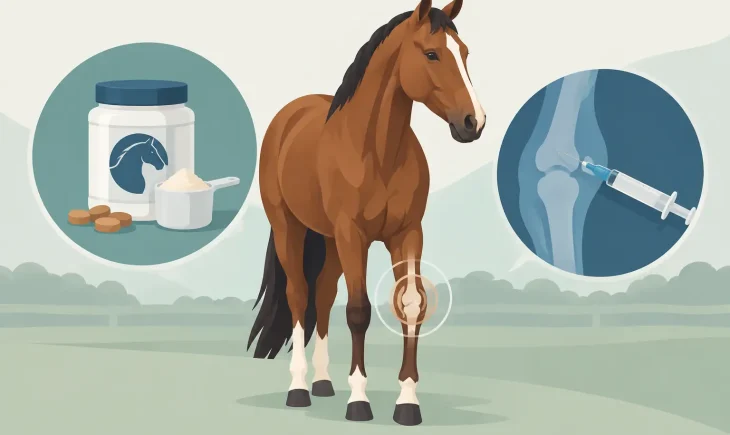
Joint supplements are generally oral products given daily or consistently over time. Their role is usually nutritional support for cartilage, synovial fluid, connective tissue, and the overall joint environment. Common ingredients include glucosamine, chondroitin sulfate, methylsulfonylmethane (MSM), hyaluronic acid, collagen, omega-3 fatty acids, and antioxidant compounds.

Injections are administered into a joint, muscle, or vein depending on the product and the veterinary treatment plan. They may include hyaluronic acid, polysulfated glycosaminoglycans, corticosteroids, biologic therapies, or other prescription treatments. Their purpose is not simply to “boost joints.” They are used to address a defined clinical concern, such as synovitis, capsulitis, osteoarthritis, or significant inflammation after a proper examination.

The practical difference is speed and precision. An oral supplement is a broad, long-term support tool. A veterinary injection can deliver a more targeted intervention, often with a faster effect when inflammation is a key driver. That does not make injections the automatic stronger option. A targeted treatment is only useful when the target is correct.

When Daily Supplements Make Sense

A well-selected oral joint supplement can be a sensible baseline for horses in regular training, older horses that remain comfortable in work, and horses with a history of mild wear-and-tear concerns. It may also suit horses moving into a more demanding season, traveling heavily, or returning to a normal conditioning program after veterinary clearance.

The benefit is consistency. Daily nutritional support is easy to build into feed routines, and it does not require a procedure each time the horse needs ongoing care. For stable managers responsible for multiple horses, this makes supplements predictable to stock, administer, and budget.

That said, not every formula delivers the same value. Look beyond a front-label claim such as “advanced joint support.” Check the active ingredients, the amount supplied per daily serving, the length of time a container lasts, and whether the horse will actually eat it. A low-cost tub is not necessarily economical if it contains underdosed ingredients or runs out in two weeks.

Supplements also require realistic expectations. Some horses appear more comfortable after several weeks of consistent use; others show little obvious change. They do not repair severe cartilage damage, correct poor hoof balance, or resolve lameness caused by a tendon injury, fracture, ulcer pain, or a back problem. If a horse is visibly lame, repeatedly stumbling, resisting collection, or deteriorating under saddle, do not mask the signs with a new powder and continue training.

When Injections May Be the Better Tool

Injections enter the conversation when there is evidence of active joint disease or clinically relevant inflammation. A veterinarian may use flexion tests, nerve or joint blocks, radiographs, ultrasound, gait evaluation, and the horse’s history to identify the source of discomfort. This diagnostic step is where the value lies. An injection placed into the wrong joint is not a shortcut to soundness.

Intra-articular treatment can be appropriate for a horse with confirmed joint inflammation that is affecting performance or comfort. Depending on the diagnosis, a veterinarian may recommend hyaluronic acid, a corticosteroid, a combination treatment, or another therapy. The selection, dose, timing, and repeat interval should reflect the individual horse, the joint involved, competition regulations, and the risks associated with the medication.

Systemic injectable products may also be part of a broader veterinary protocol. They are not interchangeable with joint injections, and they should not be treated as such. Administration route matters because it changes how a product works, what risks it carries, and what monitoring may be needed.

The major advantage of injections is that they can directly address a diagnosed inflammatory process. The trade-off is cost, procedural risk, and the need for skilled veterinary assessment. Joint injection carries a small but serious risk of infection. Steroid use requires particular judgment, especially in horses with metabolic concerns or laminitis risk. Repeated treatment without correcting workload, footing, saddle fit, shoeing, or conditioning errors can turn a useful therapy into an expensive cycle.

Cost Is More Than the Product Price

It is tempting to compare a monthly supplement cost with the price of a joint procedure and choose the cheaper number. That comparison is incomplete. A supplement is generally a recurring maintenance expense. Injections can involve examination, diagnostic imaging, sedation, sterile preparation, the product itself, and follow-up care.

However, the lowest upfront cost is not always the best value. Continuing an ineffective supplement for months while a horse works through unresolved pain can cost more in lost training, reduced performance, time off, and a worsening condition. On the other hand, scheduling injections simply because the season is starting may be unnecessary for a horse that is comfortable, sound, and responding well to sensible maintenance.

Build the budget around the horse’s actual needs. Keep records of training volume, stiffness, recovery after work, shoeing dates, changes in gait, and prior treatments. Those details give your veterinarian something more useful than “he seems a little off.” They also help reveal whether a product is genuinely helping or whether the improvement followed rest, a farrier adjustment, or a reduction in workload.

A Better Joint Care Plan Uses Both, When Needed

This is not always an either-or choice. A performance horse with diagnosed joint disease may receive veterinary treatment for a flare-up and remain on an oral joint-support program afterward. The injection addresses the immediate medical issue; the supplement supports a longer-term management routine. Neither replaces intelligent training management.

A practical program also includes conditioning that matches the horse’s fitness level, regular farrier care, appropriate warm-up and cooldown periods, stable body weight, quality forage, and recovery days. Deep or inconsistent footing can expose joint weakness quickly. So can asking a horse to perform at a level its conditioning does not support.

For horses competing under regulated rules, always check medication and withdrawal requirements before treatment. A product’s availability does not determine whether it is permitted on competition day. Keep treatment records, including product name, dose, route, administration date, and the veterinarian’s instructions. This protects the horse and avoids preventable problems at the showground or track.

Questions to Ask Before You Buy

Before choosing a joint product or arranging treatment, get specific. Is the horse actually lame, or just stiff early in work? Has the problem been localized? Is there heat, swelling, reduced range of motion, or a change in behavior under saddle? Has workload or shoeing changed recently? Are you trying to maintain a sound horse, or treat a diagnosed condition?

For supplements, ask whether the formula provides meaningful daily levels of the active ingredients and how long it should be fed before judging results. For injections, ask what diagnosis is being treated, why this product is preferred, what response is expected, what risks apply, and what management changes should accompany treatment.

The best joint-care purchase is the one that matches a clear purpose. Maintain the comfortable horse with consistent, quality support. Investigate the uncomfortable horse before asking it for more work. When the diagnosis, product, and training plan line up, you give the horse a better chance to stay useful, competitive, and comfortable for the long run.

Equine Medication Dosing for Safer Results

A 1 mL mistake can be insignificant with one product and a serious overdose with another. That is why equine medication dosing is not just a matter of following a label – it is a matter of matching the right product, strength, route, horse, and treatment schedule every time.

For owners, trainers, and stable managers responsible for valuable performance horses, accuracy protects more than a treatment plan. It protects recovery time, competition eligibility, welfare, and the confidence needed to make decisions when a horse is not performing as expected. The most cost-effective medication is the one used correctly, with no wasted product, avoidable side effects, or preventable repeat treatment.

Equine Medication Dosing Starts With the Horse

A dose is usually prescribed or labeled in relation to body weight, not what looks right in a syringe. Visual estimates are unreliable, especially with fit sport horses, heavily muscled racehorses, broodmares, ponies, and horses carrying excess condition. A horse that appears to weigh 1,100 pounds may be substantially lighter or heavier.

Use a current scale weight whenever it is available. A properly used weight tape is a practical alternative for routine management, but it is still an estimate. Recheck weight after major changes in conditioning, forage, travel, illness, or body condition. Those changes may affect the calculated amount and, in some cases, how the horse handles the medication.

The basic calculation is straightforward:

Required drug amount = prescribed dose per pound or kilogram x the horse’s body weight

The next calculation converts that drug amount into the volume or number of units to administer. This is where errors frequently occur. A label may state milligrams per milliliter, milligrams per tablet, international units per milliliter, or a percentage strength. Do not assume that two products with the same active ingredient have the same concentration.

For example, if a veterinarian directs a specific milligram amount, the volume depends entirely on the concentration printed on that exact vial or oral product. A stronger formulation means less volume is needed. Giving the same number of milliliters from a more concentrated product can create a dangerous overdose.

Check the Concentration Before Every Dose

Busy barns often keep similar-looking products in the same cabinet or treatment box. Packaging sizes change, labels differ by market, and injectable and oral formulations can carry the same active ingredient at different strengths. Read the label before drawing up a dose, even when you have used the product before.

Confirm five details before administration:

  • the horse’s identity and current weight
  • the active ingredient and product concentration
  • the prescribed dose and treatment frequency
  • the approved route of administration
  • the product expiration date and storage condition

This is particularly important with anti-inflammatory products, corticosteroids, respiratory medications, dewormers, antibiotics, and performance-support compounds. These categories can have meaningful differences in dosing intervals, contraindications, and withdrawal considerations.

A dose chart posted in the tack room can be useful for a specific horse on a veterinarian-directed course, but it should never become a permanent shortcut. Update it when the horse’s weight changes, the product strength changes, or the veterinarian changes the protocol.

Route Matters as Much as the Amount

The correct amount given by the wrong route is still an incorrect dose. Oral paste, oral liquid, intramuscular injection, intravenous injection, topical treatment, and inhaled medication each have different absorption patterns and handling requirements.

Never switch routes because one seems faster or more convenient. A product formulated for oral use may not be suitable for injection. Some injections must be administered only by a veterinarian because accidental placement, speed of administration, or reaction risk can create an emergency. Intravenous products deserve particular caution. If you have not been trained to administer a product by the labeled route, contact your veterinarian before proceeding.

For oral products, make sure the full dose is actually swallowed. A horse that resists, spits out paste, drops feed, or leaves medicated grain behind has not received a reliable dose. Dosing into a small, fully consumed amount of feed can work for certain products, but only if the label and veterinary direction allow it. Mixing a medication into a full bucket of feed is often a poor choice when exact intake matters.

For injectables, sterile technique, correct needle selection, site rotation, and proper product storage are part of dose accuracy. Contamination, a damaged stopper, poor refrigeration, or repeated use beyond the labeled in-use period can compromise a product before it ever reaches the horse.

Why “A Little More” Is Not Better

Performance-focused horse care can create pressure for rapid results. A stiff horse before an event, a respiratory issue during a training block, or slow recovery after transport may tempt a handler to increase a dose or shorten an interval. That decision can backfire quickly.

More medication does not necessarily produce more benefit. It may increase the risk of gastric, kidney, liver, metabolic, cardiovascular, or musculoskeletal complications depending on the product and the horse’s condition. Combining products from the same general class can create similar risks, even if the products have different brand names.

The reverse problem also matters. Underdosing can make treatment ineffective, particularly with parasite control and medications intended to maintain a therapeutic level over time. Partial dosing also makes it harder to judge whether the diagnosis and treatment plan are correct.

If a horse is not improving as expected, do not automatically redose. Reassess the problem. Was the diagnosis confirmed? Was the full dose administered? Has the horse’s condition changed? Is pain masking a more serious injury? Your veterinarian can determine whether the answer is a different dose, a different medication, diagnostics, rest, or an urgent examination.

Build a Treatment Record That Works in a Busy Barn

Memory is not a medication system. When multiple people handle horses, missed doses and duplicate doses become far more likely. A simple written or digital record keeps the entire team aligned.

For every treatment, record the horse’s name, date and time, product name, active ingredient, concentration, dose given, route, lot number when relevant, and the person who administered it. Add the reason for treatment and any observed response, such as appetite changes, manure changes, swelling, coughing, attitude, or gait.

This record becomes especially valuable when a veterinarian needs a quick history, when a horse changes barns, or when several products are being used during recovery. It also helps prevent a common and costly error: administering a second dose because the next handler did not know the first dose was already given.

For competition horses, maintain withdrawal and medication records separately from day-to-day notes. Rules vary by discipline, jurisdiction, and event. A product that is legal to possess or use may still be restricted on competition day, and withdrawal guidance is not a guarantee of a negative test. Confirm the current rules for the specific governing body and event, then plan treatment well ahead of shipping.

When to Stop and Call the Veterinarian

Some situations should not be handled by adjusting a dose at home. Contact a veterinarian promptly if the horse develops facial swelling, hives, breathing difficulty, collapse, severe diarrhea, colic signs, marked depression, neurologic changes, injection-site pain or swelling, or an unexpected deterioration after treatment.

Also call before dosing if the horse is dehydrated, off feed, pregnant, nursing, very young, geriatric, known to have kidney or liver concerns, or already receiving several medications or supplements. These factors can change the safety margin considerably.

Buying equine health products at a competitive price can make it easier to keep essential treatment supplies available, but availability should never replace a sound dosing plan. Equine MedCare customers who keep a well-organized treatment cabinet can act faster when a veterinarian recommends a product – provided the horse, label, concentration, and route are checked first.

The best habit in any stable is simple: pause before you dose. Read the label, calculate from current weight, confirm the route, document the treatment, and ask for veterinary direction whenever the situation is unclear. That extra minute is one of the strongest safeguards you can give a horse.

Equine Injectable Safety for Every Horse Program

A misplaced injection can cost far more than a missed training day. Swelling, infection, muscle damage, an avoidable reaction, or a competition violation can put a valuable horse out of work fast. Equine injectable safety is not only about handling a needle correctly. It starts with choosing a verified product, confirming the exact drug and concentration, and knowing whether an injection is appropriate for that individual horse.

For stable managers, trainers, breeders, and owners managing performance horses, injectables can be a practical part of a veterinary treatment plan. They may be used for inflammation, respiratory concerns, recovery support, joint protocols, nutritional deficiencies, parasite control, or other diagnosed needs. But injectable products are not interchangeable with oral products, and faster administration does not mean lower risk.

Equine Injectable Safety Starts Before Administration

The first safety check happens before a product leaves the medicine cabinet. Confirm the horse’s identity, current body weight, treatment history, and reason for administration. A horse that has recently received an anti-inflammatory, corticosteroid, sedative, supplement, or performance-support compound may have interaction risks that are not obvious when products are viewed one at a time.

Read the full label every time, even if the product is familiar. Check the active ingredient, concentration, route of administration, expiration date, storage requirements, and the number of doses remaining in the vial. Similar product names, different strengths, and multi-dose packaging can create expensive errors in a busy barn.

Do not estimate dose volume from memory. The dose for a 1,000-pound mature sport horse may be very different from the dose for a young horse, pony, broodmare, or horse recovering from illness. Use a current weight or a reliable weight tape estimate, then follow veterinary direction and the product label. If instructions conflict, stop and verify before proceeding.

Product condition matters as much as the label. Do not use an injectable if it is expired, has been stored outside its stated temperature range, shows unexpected discoloration, particles, leakage, a damaged seal, or an unclear label. Some formulations must be protected from light, while others should not be frozen. A discounted price is only a genuine saving when the product remains authentic, in date, and correctly handled from shipment through storage.

Match the Route to the Product and the Plan

An injection route is not a minor detail. Intramuscular, subcutaneous, intravenous, intra-articular, and other routes have different absorption patterns, risks, and administration standards. A product intended for intramuscular use should never be assumed safe for intravenous use. A change in route can alter how quickly a drug acts, how long it lasts, and how likely it is to cause serious harm.

Intravenous administration deserves particular caution. It should be performed only by a veterinarian or a properly trained professional working within veterinary direction. An error in vein access, injection speed, product selection, or dose can lead to severe complications within minutes. Joint injections and other specialized procedures also require a sterile clinical setting and trained veterinary judgment because infection in a joint can be catastrophic.

Even routine intramuscular injections should be handled with a clear protocol. Use the recommended injection site, select the appropriate needle size for the product and horse, and avoid repeatedly using the same location. Rotate sites when a treatment plan involves more than one injection. A horse that is tense, painful, or likely to move suddenly needs calm, experienced handling – not a rushed attempt in a crowded aisle or during feeding time.

If a horse is difficult to inject, do not turn the situation into a contest. Stop, reassess restraint and environment, and contact your veterinarian or an experienced equine professional. A frightened horse can injure itself, its handler, and anyone nearby in seconds.

Clean Technique Protects More Than the Injection Site

Every injection breaks the skin barrier. That means bacteria can enter if preparation is poor. Start with clean hands, a clean work surface, and a new sterile needle and syringe. Never reuse needles or syringes between horses. Never share a needle between products. Reuse increases contamination risk, dulls the needle, and makes injections more painful.

Prepare the site according to the product and veterinary protocol. The hair and skin should be visibly clean, and the area should be allowed to dry after antiseptic preparation when indicated. Avoid injecting through mud, sweat, manure, topical products, or visibly irritated skin. If the site is swollen, warm, painful, scarred, or recently injected, choose another appropriate site under professional guidance.

Keep multi-dose vials protected from contamination. Use a new sterile needle each time you enter the vial. Do not leave needles inserted in vial stoppers, and do not transfer leftover medication into another container. Record the date a vial was first opened if the product has a specified in-use period. This simple habit prevents a common problem: using a vial that looks acceptable but is no longer suitable for administration.

Watch the Horse After Every Injection

An injection is not finished when the needle is removed. Observe the horse closely after administration, especially when the drug is new to that horse, the product is being given for the first time, or multiple medications are involved. Early recognition gives your veterinarian the best chance to respond effectively.

Call a veterinarian promptly for signs such as facial swelling, hives, labored breathing, marked anxiety, collapse, severe sweating, colic signs, unusual weakness, or sudden lameness. These may indicate a serious reaction and should not be handled with guesswork or a second medication chosen from the tack room.

Monitor the injection site over the next several days. Mild tenderness can occur with some products, but increasing heat, firm swelling, drainage, fever, reluctance to move, or worsening pain can signal infection or tissue injury. Do not massage a painful or swollen site unless your veterinarian specifically advises it. The right response depends on the medication used, the injection route, and the horse’s clinical signs.

A written treatment record is one of the strongest tools in a professional horse program. Record the date and time, horse, product name, concentration, dose, route, injection site, lot number when available, person administering it, and any reaction observed. This makes follow-up safer, helps avoid duplicate dosing, and gives the veterinarian useful information if a problem develops.

Performance Horses Need a Compliance Check

For show, racing, and sport horses, medication safety includes the rulebook. A product can be clinically appropriate and still create a prohibited substance result if used too close to competition or outside applicable regulations. Withdrawal and detection times are not universal. They can vary by governing body, dose, route, formulation, testing method, and the horse itself.

Do not rely on a friend’s schedule, an old barn chart, or an online comment when a competition date is approaching. Discuss treatment timing with your veterinarian and check the rules for the specific organization and event. Keep treatment records available. For high-value competition horses, that paperwork is part of risk management, not paperwork for its own sake.

This is especially relevant with corticosteroids, anti-inflammatory drugs, respiratory medications, recovery compounds, and injectable supplements. “Natural,” “wellness,” or “support” language does not automatically mean competition-safe. The ingredient list, administration history, and governing-body rules determine the risk.

Buy Carefully, Store Correctly, Dispose Safely

A safe injectable program depends on the supply chain. Buy products with clear labeling, stated strengths, intact packaging, and appropriate storage information. When ordering internationally, allow for delivery timing and storage needs rather than waiting until the last vial is nearly empty. Equine MedCare customers should also check products as soon as they arrive and move temperature-sensitive items into proper storage without delay.

Keep medications in a secure, dry location away from children, unauthorized staff, feed, and direct sunlight. Maintain separate areas for sterile supplies, used sharps, and medication inventory. Do not store needles loose in drawers or leave prepared syringes unlabeled for later use.

Used needles and syringes belong in an approved sharps container. Never throw them into regular trash, recap them by hand if avoidable, or leave them in a stall, trailer, or grooming tote. Follow local disposal requirements for sharps and unused medication. Proper disposal protects barn staff, veterinary teams, waste handlers, and other animals.

The best injectable decision is often the one made before a horse needs urgent treatment: keep a clean inventory, know your veterinary contacts, train staff on recordkeeping, and do not cut corners because the schedule is tight. When the product, route, technique, and horse all match the plan, you protect both equine health and the performance program built around it.

How to Administer Oral Horse Medication Safely

A horse can spot a hidden tablet in a feed bucket with remarkable accuracy. Knowing how to administer oral horse medication without turning every dose into a fight protects the treatment plan, reduces waste, and keeps both horse and handler safer. The right method depends on the product, the horse’s behavior, and whether the full dose must be confirmed immediately.

Oral medications can be highly effective, but only when the horse receives the intended amount at the intended interval. A partially eaten medicated meal, a paste dropped onto the stable floor, or a crushed tablet that should have remained intact can change the result. Start with the product label and the directions supplied by your veterinarian, then choose the administration method that gives you the best control.

Check the Medication Before You Dose

Before opening a syringe, packet, or tub, confirm the horse’s identity, the product name, concentration, dose, route, and dosing schedule. This matters in busy barns where several horses may receive supplements, dewormers, anti-inflammatory medications, respiratory products, or recovery support on the same day.

Read the label every time, especially when switching between package sizes or concentrations. A paste syringe may be marked by body weight, while a liquid may require measurement in milliliters. Do not assume two products with a similar name, flavor, or active ingredient have the same strength.

Check the expiration date and storage instructions. Heat, moisture, freezing, and direct sunlight can affect some formulations. If a liquid has separated, changed color, developed an unusual odor, or contains particles when it should be clear, stop and confirm with the dispensing professional before use.

The horse should be able to swallow normally and should not be heavily sedated, choking, or showing signs of colic. If a horse coughs repeatedly while eating, has feed or saliva coming from the nostrils, or struggles to swallow, do not attempt to force an oral dose. Those signs need veterinary attention.

Choose the Best Oral Medication Method

The best approach is the one that ensures the horse receives the full dose with the least stress. For an easy horse taking a palatable powder or granule, a small feed carrier may work well. For a time-sensitive paste or an unpleasant-tasting medication, direct oral dosing is usually more reliable.

Paste and Gel Syringes

Paste syringes are common for dewormers, electrolytes, supplements, and certain medications. Set the syringe ring or dial to the prescribed dose before approaching the horse. If the product is weight-based, use a current and realistic body-weight estimate rather than guessing. Underestimating weight can lead to an inadequate dose, while overdosing can create avoidable risk.

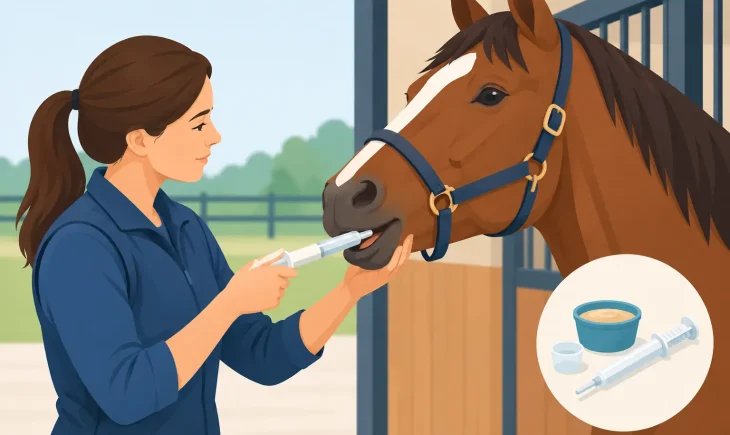
Fit the horse with a halter and stand at the side of the head, not directly in front. Hold the lead rope securely, but do not wrap it around your hand. With one hand, gently raise the horse’s head just enough to keep it from immediately dropping and ejecting the paste.

Insert the syringe through the gap between the incisors and cheek teeth, known as the interdental space. Aim the tip toward the back of the tongue, along the side of the mouth. Do not push the syringe straight down the throat or force it against the teeth. Deliver the paste steadily, withdraw the syringe, and keep the head elevated briefly while the horse swallows.

Watch for a swallow and check that the horse has not deposited the dose in its cheek or spat it out. If you are unsure how much was lost, do not automatically repeat the full dose. Contact your veterinarian or the product supplier for guidance, because redosing can be unsafe with some medications.

Tablets and Capsules

Tablets are often more difficult because horses can separate them from feed. Some tablets may be placed directly into the mouth using a pill gun designed for horses, while others can be hidden in a small amount of a suitable treat or feed. Direct administration gives the best confirmation, but it requires a calm horse and confident handling.

Never crush, split, dissolve, or open a tablet or capsule unless the label or a veterinarian says it is acceptable. Coated, extended-release, delayed-release, and enteric-coated products may not work correctly once altered. Crushing can also expose the handler to drug dust, which is a concern with certain hormones, corticosteroids, chemotherapy-related drugs, and other potent products.

When using a pill gun, load the tablet according to the device instructions. Place it through the interdental space, position it as far back on the tongue as safely possible, release the tablet, and remove the device promptly. Keep the horse’s head slightly raised until it swallows. A small oral syringe of water may help with swallowing when approved for the product and horse.

Powders, Granules, and Liquids in Feed

Feed administration is convenient, especially for long-term supplements or products designed to be mixed with ration. The risk is simple: if the horse does not finish the feed, you do not know how much medication it received.

Use a small, highly palatable carrier first, such as a modest portion of soaked pellets, mash, or another veterinarian-approved feed the horse reliably eats. Mix the full measured dose thoroughly into that small portion and wait until it is completely consumed before offering the normal meal. Do not hide medication in a full bucket of grain or hay if accurate dosing matters.

For liquids, use a marked oral syringe or measuring device rather than estimating by capfuls. Mix only if the label allows it. Some liquids are best administered directly by syringe into the side of the mouth, particularly when the taste is strong or the horse has a history of leaving medicated feed.

Make the Process Safer for Horse and Handler

A quiet setup saves time. Dose the horse in a familiar stall, cross-tie area, or safe grooming space with adequate light and minimal activity. Have the measured medication ready before bringing the horse into position. Searching for a syringe while the horse becomes impatient is an easy way to lose control of the session.

Use clean equipment for every dose. Rinse and dry reusable oral syringes between products, and never use the same dosing tool for multiple horses unless it can be properly cleaned. This helps prevent cross-contamination and protects the accuracy of future doses.

If a horse becomes defensive, raises its head out of reach, strikes, rears, or repeatedly refuses handling, do not escalate into a physical contest. The safer answer may be training, a different formulation, a more palatable carrier, or veterinarian-directed sedation in specific circumstances. Forcing the issue can create a long-term aversion to oral treatment and increase injury risk.

Avoid Common Dosing Mistakes

The most frequent problem is assuming a dose was swallowed when it was not. Stay with the horse for a moment after administration. Check the lips, cheeks, feed tub, bedding, and front of the stall for dropped paste, tablets, or wet medication.

Another mistake is doubling a dose after a missed or uncertain administration. Some products have a wider safety margin than others, but that decision should be based on the specific active ingredient, the horse’s size, health status, and timing. Call the prescribing veterinarian if the dose was missed, vomited up by an unusual event, spilled, or only partly consumed.

Keep a written medication record in the barn. Include the horse’s name, product, lot number when relevant, dose, route, date, time, person administering it, and any observed reaction. In a training or breeding operation, this record also helps manage withdrawal times and competition rules. Requirements vary by discipline, location, and medication, so verify them before an event rather than relying on old barn notes.

Pay attention after the first dose and after any dose change. Reduced appetite, diarrhea, hives, facial swelling, agitation, depression, unusual sweating, or changes in drinking behavior deserve prompt attention. Severe breathing difficulty, collapse, marked swelling, or signs of choking require urgent veterinary help.

Build a Reliable Dosing Routine

For horses on ongoing oral therapy, consistency is part of treatment. Give the medication at approximately the same time each day, use the same method when practical, and avoid changing feed carriers without a reason. A horse that accepts a small medicated mash at evening feeding may refuse it after a sudden switch in flavor, texture, or routine.

It is worth keeping suitable oral dosing supplies on hand: appropriately sized syringes, clean measuring tools, gloves for products that require them, and a reliable way to record doses. When you source horse health products, choose clearly labeled formulations and order before the current supply is close to empty. Equine MedCare offers a broad selection of oral horse products for owners and managers who need practical access to treatment and performance-support options.

A calm handler, an accurate dose, and a method the horse accepts are more valuable than any trick for hiding medication. When in doubt, slow down, confirm the label, and ask for veterinary direction before the next dose.

Flumethasone Side Effects in Horses: Key Risks

A horse can look dramatically more comfortable after corticosteroid treatment, which is exactly why flumethasone side effects horses may develop deserve close attention. Reduced swelling, easier movement, and improved breathing can be useful treatment outcomes, but steroid medications can also change how the body handles infection, healing, metabolism, and stress. For performance horses, that trade-off needs to be managed carefully rather than treated as an afterthought.

Flumethasone is a corticosteroid used for its anti-inflammatory and anti-allergic effects. The risks are not identical for every horse or every product. They depend on the formulation, dose, route of administration, treatment length, the horse’s existing health status, and whether other medications are being used at the same time. A veterinarian should direct the diagnosis, treatment plan, and withdrawal strategy for any horse in work or competition.

Why flumethasone requires careful management

Corticosteroids suppress inflammatory activity. That can be valuable when inflammation itself is causing pain, airway narrowing, skin irritation, or other clinical problems. The same action can mask a worsening injury or infection if the horse is returned to training too soon.

A sounder-looking horse is not always a fully recovered horse. If a horse becomes comfortable enough to train harder while tendon, ligament, joint, hoof, or soft-tissue damage remains active, the original issue can become more serious. Use the treatment period to reassess the cause of the problem, not simply to push through it.

Potency also matters. Flumethasone products are not interchangeable with other corticosteroids just because they are all described as anti-inflammatory drugs. Check the active ingredient, concentration, route, expiration date, and product directions every time. Never estimate an amount based on another steroid product in the tack room.

The most significant flumethasone side effects in horses

Laminitis and hoof pain

Laminitis is the side effect most horse owners and trainers watch for when corticosteroids are involved. The relationship is not simple: many horses receive corticosteroids without developing laminitis, and horses may have underlying metabolic or systemic risks that contribute to the outcome. Still, corticosteroid use can be a serious concern in susceptible horses.

Risk is higher in horses with a history of laminitis, insulin dysregulation, equine metabolic syndrome, obesity, Cushing’s disease or PPID, or an active systemic illness. Ponies and easy keepers may require particular caution. A horse with digital pulse increases, warm feet, a shortened stride, reluctance to turn, shifting weight, or a rocked-back stance needs prompt veterinary assessment. Do not wait to see if hoof soreness disappears after the next feed or turnout.

Lowered resistance to infection

By calming immune and inflammatory responses, flumethasone may make it harder for the horse to contain an infection. This is a major consideration for horses with fever, unexplained lethargy, draining wounds, respiratory discharge, dental disease, skin infections, or an infection around a joint, tendon sheath, or hoof.

The medication can also soften the visible signs of inflammation. A wound may look less swollen while bacteria remain active beneath the surface. Monitor temperature, appetite, attitude, wound appearance, and drainage. If a horse seems dull, loses appetite, develops a fever, or has increasing pain after treatment starts, contact the veterinarian promptly.

Delayed healing and tissue effects

Inflammation is not always harmful. It is part of normal tissue repair. Suppressing it too strongly or for too long may delay healing, especially where there is a surgical incision, open wound, skin injury, or active soft-tissue lesion.

Longer exposure to corticosteroids can also contribute to muscle loss, weakness, poor coat condition, and reduced tissue quality in some horses. These effects are more relevant with repeated or extended systemic treatment than with a short, veterinarian-directed course, but the horse’s condition should still be followed closely. A performance horse that loses topline, feels weak behind, or recovers poorly after light work needs reassessment rather than a harder conditioning schedule.

Increased thirst, urination, and appetite changes

Some horses experience increased drinking and urination during corticosteroid treatment. Appetite can increase as well. These changes may be mild, but they matter in a stable setting because sudden water consumption or excessive wet bedding can also signal metabolic disease, kidney concerns, or other problems.

Track what is normal for that horse. If a horse is drinking substantially more, is difficult to keep hydrated, shows colic signs, or develops notable behavior changes, report it to the prescribing veterinarian. This is particularly useful for broodmares, older horses, and horses already receiving multiple medications or supplements.

Stomach and intestinal concerns

Corticosteroids can create additional gastrointestinal concern, especially when combined with non-steroidal anti-inflammatory drugs, commonly called NSAIDs. Phenylbutazone, flunixin, and similar medications have their own risks for the stomach, intestinal tract, and kidneys. Combining anti-inflammatory drugs without veterinary direction can increase the chance of complications.

Poor appetite, teeth grinding, girthiness, loose manure, colic behavior, diarrhea, or dark manure should not be written off as ordinary stress. The correct plan may involve changing medication, testing for another cause, or providing targeted support, but that decision should be based on the horse’s actual clinical picture.

Horses that need extra caution

Before flumethasone is considered, give the veterinarian a complete picture. Mention prior laminitis, dietary restrictions, PPID status, insulin testing, current turnout, recent illnesses, breeding status, and every medication or supplement being used. A horse that looks fit can still have metabolic risk factors, particularly mature easy keepers and horses with regional fat deposits.

Extra caution is appropriate for horses with:

  • A prior episode of laminitis or ongoing hoof sensitivity
  • PPID, insulin dysregulation, obesity, or equine metabolic syndrome
  • Fever, respiratory infection, wounds, abscesses, or unexplained swelling
  • Active ulcers, diarrhea, recurrent colic, or poor appetite
  • Recent surgery, significant injury, or slow-healing skin lesions
  • Current NSAID treatment or repeated corticosteroid exposure

Competition horses add another layer. Medication rules, detection times, and withdrawal requirements vary by discipline, governing organization, country, dosage, and route. Do not assume a product is permitted because it improved the horse clinically or because another stable has used it. Confirm requirements well before entries, transport, or testing.

Practical monitoring during treatment

The best monitoring plan is simple enough that it actually gets done. Take a baseline before treatment when possible: temperature, appetite, water intake, manure output, digital pulse, hoof warmth, lameness level, and the condition being treated. During treatment, compare the horse against that baseline daily.

Keep training conservative until the underlying issue has been evaluated. If flumethasone is being used for a respiratory or allergic problem, monitor effort at rest, coughing, nasal discharge, and recovery after only veterinarian-approved work. If it is being used around an injury, do not let reduced pain become the reason to skip rest, imaging, farrier support, or rehabilitation steps.

Call the veterinarian urgently for signs of laminitis, fever, severe depression, colic, diarrhea, rapidly worsening swelling, labored breathing, or marked changes in appetite and drinking. Early action is generally less costly and gives the horse a better chance of a clean recovery.

Buying and handling corticosteroid products responsibly

Fast access and competitive prices can help stable managers keep essential treatment supplies organized, especially when managing several horses. But corticosteroid purchases should remain product-specific. Confirm that the medication is intended for the horse’s condition and planned route of use, and store it according to the label.

Equine MedCare customers should also check package strength and volume carefully before ordering. Similar product names, different concentrations, and different routes can create avoidable errors. Keep medications secured, use clean handling practices, and never share needles, syringes, or partially used injectable products between horses.

A corticosteroid can be a practical part of a horse’s treatment plan when it is matched to the right case and monitored with discipline. The useful question is not only whether flumethasone will make the horse feel better today, but whether the full plan protects soundness, recovery, and long-term performance tomorrow.

Thymosin Beta 4 for Horses and Recovery

A tendon injury does not care how valuable the next race, show, or breeding date may be. That is why interest in thymosin beta 4 horses has grown among owners and trainers looking for recovery-support options after soft-tissue damage. But this is not a product to treat as a routine performance supplement. Its proposed role, legal status, administration route, and competition implications all need to be considered before a treatment decision is made.

Thymosin beta 4 is often discussed in performance-horse circles because it is associated with tissue repair pathways. The attraction is obvious: a horse with a tendon, ligament, muscle, or wound-healing problem can face a long layup, uncertain prognosis, and substantial lost value. Still, faster recovery claims should always be separated from established veterinary evidence and a disciplined rehabilitation plan.

What Is Thymosin Beta 4 for Horses?

Thymosin beta 4 is a naturally occurring peptide found in many tissues in the body. It is involved in cell movement, inflammation signaling, blood-vessel formation, and tissue repair processes. In research settings, it has been investigated for possible effects on wound healing and recovery after injury.

For horses, products sold as thymosin beta 4 may be marketed as injectable recovery compounds. They are generally considered when a veterinarian is managing soft-tissue injury, delayed healing, surgical recovery, or significant tissue trauma. The intended goal is not to replace correct diagnosis or rest. It is to support a recovery program that still depends on controlled exercise, imaging, farriery where needed, nutrition, and repeat veterinary evaluation.

The key distinction is important. A peptide associated with healing biology is not automatically a proven cure for every bowed tendon, suspensory lesion, muscle strain, or wound. Injury location, severity, chronicity, the horse’s age, and workload all affect the outcome.

Why Recovery Cases Require Careful Decisions

In a high-value horse, pressure to return to work can lead to poor choices. A horse may look sound before injured tissue has regained enough strength for speed, jumping, hard turns, or repeated loading. That gap between clinical appearance and actual tissue readiness is where reinjury happens.

Thymosin beta 4 may be considered as one element of a broader plan, but it cannot compensate for a rushed schedule. Ultrasound findings, lameness examinations, gait assessment, and the horse’s response to graduated work should guide the next step. A horse that is comfortable at the walk is not necessarily ready for fast work, a demanding course, or race training.

Owners should also be realistic about evidence. Much of the interest around thymosin beta 4 comes from laboratory findings, non-equine research, and practical experience rather than large, definitive clinical trials in horses. That does not make every use inappropriate. It does mean a veterinarian should weigh the potential upside against the uncertainty for the individual case.

Situations where veterinarians may discuss it

The conversation may arise around tendon and ligament rehabilitation, difficult wounds, post-procedure recovery, or muscle and soft-tissue trauma. Each situation has different priorities. A superficial wound may need cleaning, debridement, bandaging, infection control, and protection from proud flesh. A tendon lesion may need a long, staged loading program. Treating both as if they need the same recovery product is not sound horse management.

A full veterinary workup also matters because apparent soft-tissue pain can have another cause. Joint disease, hoof imbalance, bone injury, neck pain, ulcers affecting movement, or an underlying infection can all change the treatment plan.

Administration, Product Quality, and Safety

Products labeled thymosin beta 4 are often supplied for injection. Injectable products require much more than simply selecting a vial and calculating a dose. Sterile handling, appropriate storage, accurate identification of the active ingredient, and professional direction are central to reducing avoidable risk.

Do not assume that similarly named products are interchangeable. Formulation, concentration, volume, excipients, manufacturing standards, and storage instructions can differ. A label should clearly identify the ingredient, strength, lot information, expiration date, and handling requirements. If a product arrives damaged, warm when it requires temperature control, without adequate labeling, or with an unusual appearance, do not use it until the supplier and veterinarian have clarified the issue.

Potential concerns can include injection-site reactions, contamination from poor technique, unexpected sensitivity, and unknown effects in horses with complex medical conditions. The research base may also be limited for certain uses, doses, and combinations with other medications. Breeding animals, pregnant mares, young horses, and horses with systemic illness deserve especially cautious case-by-case assessment.

No online article can responsibly provide a universal dosing protocol. Dose and schedule should be established by a qualified veterinarian who knows the horse’s diagnosis, body weight, current medications, and intended level of activity. More product is not a substitute for better rehabilitation.

Competition Rules Can Change the Decision

For racing and regulated equestrian sport, thymosin beta 4 can create a major compliance issue. Rules vary by governing body, jurisdiction, product formulation, test method, and date. A substance may be prohibited at all times, prohibited in competition, subject to a threshold, or treated differently as rules evolve.

Never rely on a trainer’s old withdrawal chart, an internet forum, or a supplier statement as proof that a product is permitted. Before use, check the current rules of the relevant racing commission, federation, or event organizer. Then discuss the risk with the attending veterinarian. A horse can test positive even when the intention was recovery rather than performance enhancement, and the consequences can reach the owner, trainer, rider, and veterinarian.

This is especially relevant when a horse may change plans. A horse bought for rehabilitation today may be entered in a sale, race, futurity, or show sooner than expected. Keep accurate records of every treatment, including product name, lot number, amount used, route, date, time, and the person who administered it. Good records protect horse welfare and make compliance questions easier to answer.

Building a Recovery Plan That Holds Up

The strongest recovery plan is usually less dramatic than owners want it to be. It starts with an accurate diagnosis and a realistic timeline. For tendon and ligament injuries, scheduled rechecks and diagnostic imaging can show whether tissue is organizing properly before workload increases. For wounds, monitoring heat, swelling, discharge, odor, granulation tissue, and pain helps catch setbacks early.

Management should also match the horse. A quiet stall rest plan may work for one horse and create dangerous stress for another. Controlled turnout, hand-walking, sedation when medically appropriate, changes in diet, and environmental management may all be needed to keep rehabilitation safe. The best protocol is one the horse can actually follow without repeated incidents.

Nutrition deserves attention as well. Adequate quality protein, forage, minerals, hydration, and body-condition control support recovery, while excess calories can make restricted horses harder to manage. Supplements may have a place, but they should not distract from fundamentals such as proper hoof balance, sound tack, training surfaces, and a sensible return-to-work schedule.

Buying with a Clear Purpose

When sourcing specialized equine recovery products, prioritize product transparency and practical service. Confirm the exact formulation you are purchasing, whether storage requirements can be maintained during shipping, and whether the item is appropriate for veterinary-directed use in your location. Price matters, particularly during long rehabilitation periods, but a low cost is not a reason to skip label review or professional guidance.

Equine MedCare serves owners and stable teams seeking access to specialized horse-health products with competitive pricing and international delivery options. Before adding any peptide or injectable product to a cart, have the treatment objective written down: what injury is being addressed, what the veterinarian expects to monitor, and what would signal that the plan needs to change.

A good recovery decision is not the one that promises the quickest comeback. It is the one that gives the horse the best realistic chance of returning sound, staying sound, and meeting the rules of the job ahead.

Clenbuterol for Horse Breathing Explained

A horse that starts coughing in warm-up, takes longer to recover after work, or seems to push air rather than move freely is not simply having an off day. Clenbuterol for horse breathing may be considered when airway narrowing is part of the problem, but it is not a catch-all answer for every respiratory noise, cough, or drop in performance.

Clenbuterol is a bronchodilator. It relaxes smooth muscle in the airways, helping open narrowed bronchial passages so the horse can move air more easily. For horses affected by bronchospasm or lower-airway obstruction, that action can make a meaningful difference in comfort and exercise tolerance. The key is using it for the right horse, at the right stage of the respiratory plan, under veterinary direction.

What clenbuterol does for equine airways

Clenbuterol is a beta-2 agonist bronchodilator. In plain terms, it signals airway muscles to relax. When those muscles are constricted, the airway diameter becomes smaller, resistance rises, and breathing requires more effort. Opening the airways can reduce that resistance.

It is commonly discussed in connection with equine asthma, including horses previously described as having recurrent airway obstruction or inflammatory airway disease. These horses may show cough, nasal discharge, increased respiratory effort, poor stamina, slow recovery, or a visible abdominal push while breathing. Some are worse in dusty stalls or arenas; others flare during certain seasons, around moldy forage, or with heavy pollen exposure.

A bronchodilator can improve airflow, but it does not remove airborne dust, treat a bacterial infection, resolve heaves caused by poor stable management, or repair upper-airway dysfunction. That distinction matters. A horse may look better after airway relaxation while the underlying inflammation or environmental trigger continues.

When clenbuterol for horse breathing may fit

Clenbuterol is generally most useful when a veterinarian identifies lower-airway constriction as part of the horse’s condition. A clinical examination may include listening to the lungs, endoscopy, a tracheal wash, bronchoalveolar lavage, bloodwork, or a review of the horse’s stable environment and work pattern.

It may be used as part of a plan for a horse with equine asthma that is struggling with bronchoconstriction. It can also be considered when the veterinarian wants to improve airway comfort while other measures, such as anti-inflammatory treatment and dust control, begin to work.

The practical benefit is often easiest to see in a horse that has obvious respiratory effort at rest or during exercise. The horse may breathe more quietly, recover more normally, and show less visible effort. But a faster recovery alone does not prove the treatment is solving the entire issue. Owners and trainers should still track cough frequency, respiratory rate, appetite, attitude, work tolerance, and recurrence after treatment changes.

It is not the answer for every poor performance case

Respiratory symptoms can overlap with many other problems. Upper-airway conditions, including laryngeal dysfunction or soft palate issues, may cause noise and exercise intolerance but will not necessarily respond to a lower-airway bronchodilator. Fever, thick nasal discharge, contagious respiratory disease, cardiac disease, pain, gastric discomfort, anemia, and poor conditioning can also affect performance.

If a horse has fever, depression, reduced appetite, yellow or green nasal discharge, severe respiratory distress, or rapid deterioration, treat that as a veterinary priority rather than a product-selection problem.

Bronchodilation is only one part of the plan

For many horses, the biggest long-term gains come from reducing what irritates the airways every day. A medication can open the airway, but a dusty hay net hanging directly in front of the horse for hours can keep driving inflammation.

Stable managers should look closely at forage quality, bedding, ventilation, and arena dust. Steaming or soaking hay when appropriate, choosing low-dust bedding, improving airflow, feeding from the ground when practical, and avoiding sweeping or blowing dust around stabled horses can reduce respiratory challenge. Turnout may help some horses, though pollen and seasonal triggers can make the result less predictable for others.

Where inflammation is confirmed, veterinarians may combine bronchodilator therapy with corticosteroid treatment or other targeted management. The best program depends on severity, the horse’s history, the intended workload, and whether competition regulations apply. A horse with mild intermittent coughing may need a very different approach than a horse with advanced equine asthma and labored breathing at rest.

Administration, timing, and monitoring

Clenbuterol products are available in formulations designed for veterinary use. The route, concentration, treatment duration, and schedule should follow the specific product labeling and the prescribing veterinarian’s instructions. Do not estimate a dose from another horse’s protocol, a forum post, or a product with a different concentration.

Monitoring matters because clenbuterol affects more than the lungs. Potential adverse effects can include increased heart rate, sweating, muscle tremors, nervousness, restlessness, and changes in appetite. These effects may be more noticeable in sensitive horses or if dosing is not appropriate. Horses with known heart concerns deserve particularly careful veterinary assessment.

Repeated or prolonged use can also become less effective as the body’s response changes. That is another reason to use clenbuterol as part of a defined treatment plan rather than as a routine performance shortcut. If the horse’s cough and breathing return as soon as treatment stops, the answer may be stronger environmental control, reassessment of inflammation, or a closer look at the diagnosis.

Keep clear treatment records. Note the product, concentration, amount given, date, time, response, and any side effects. For a stable with multiple handlers, this is essential for avoiding missed doses or accidental duplicate administration. It also gives the veterinarian useful information if the treatment plan needs adjustment.

Competition rules and responsible use

For racing, showing, and other regulated competition, clenbuterol requires careful attention. Rules differ between organizations, countries, disciplines, and individual events. A product can be medically appropriate yet still create a prohibited-substance issue if administered too close to competition or without the required documentation.

Never assume a withdrawal period from another barn, another jurisdiction, or an old rulebook applies to your event. Confirm current regulations with the governing body and speak with the attending veterinarian before entering a horse. Training barns should also separate treatment records from informal verbal instructions. A simple written log can protect both horse welfare and the team responsible for the entry.

Clenbuterol should not be treated as a tool to force more output from a horse whose breathing problem has not been diagnosed. Better airflow does not make a compromised horse fit to compete. The goal is to restore comfortable, healthy breathing and make sound decisions about workload.

Questions to ask before starting treatment

Before selecting clenbuterol for a horse, ask what evidence points to bronchoconstriction, what trigger is likely driving the problem, and how success will be measured. Ask whether anti-inflammatory treatment, environmental changes, or additional testing should be part of the same plan. If the horse competes, confirm the applicable medication rules before treatment begins, not at the showgrounds.

For owners and trainers sourcing specialized equine respiratory products, product strength, formulation, storage, and shipping reliability all matter. Equine MedCare focuses on giving experienced horse people access to a broad range of equine health products with value-led pricing and express international delivery, but the correct product should always follow a clear veterinary plan.

A horse that breathes freely can train, recover, and live more comfortably. Start with the diagnosis, remove the respiratory triggers you can control, and use clenbuterol only where it has a real clinical job to do.

EIPH Symptoms in Racehorses to Watch For

A horse can come back from a hard work looking bright, finish its feed, and still have blood in its lower airways. That is why EIPH symptoms in racehorses deserve attention even when there is no obvious blood at the nostrils. Exercise-induced pulmonary hemorrhage can reduce airflow, affect recovery, and take a costly edge off a horse that otherwise appears fit to run.

What EIPH symptoms in racehorses can look like

EIPH occurs when intense exertion causes bleeding into the airways. It is most associated with high-speed racing, but the amount of bleeding varies widely. Some horses show clear signs after a race or fast breeze. Many show none that can be seen from the shedrow.

Visible blood is a serious but uncommon sign

Epistaxis, or blood coming from one or both nostrils after exercise, is the sign most people associate with a bleeder. It needs immediate veterinary attention and should never be dismissed as a minor post-race issue. However, visible nasal bleeding represents only a small proportion of horses with EIPH.

A horse may have blood deeper in the trachea or bronchi without a drop appearing at the nostrils. Waiting for epistaxis before investigating can mean missing mild or moderate EIPH that is already affecting performance.

Subtle changes often show up first

The less obvious signs are often the ones trainers and riders notice first. A racehorse may tire earlier than expected, fail to finish with its usual determination, or take longer to recover after a gallop. Some horses cough once or repeatedly after work, swallow more than usual, or make an abnormal respiratory noise.

Poor performance alone does not prove EIPH. It can also reflect pain, poor fitness, heat stress, upper airway obstruction, lower airway inflammation, infection, ulcers, or a training issue. The useful question is whether the change is repeatable and linked to hard exertion.

Performance clues worth tracking

A single flat performance can happen for dozens of reasons. A pattern is more useful. Keep clear notes on the horse’s speed work, recovery rate, coughs, respiratory noise, appetite, behavior, and results. Compare each horse with its own normal baseline rather than another horse in the barn.

Possible warning signs include a horse that fades late despite normal early pace, needs longer to return to normal breathing, resists finishing work, or returns from the track with a wet cough. A reduced desire to train can matter as much as a dramatic respiratory sign. High-level horses frequently mask discomfort until their performance drops.

Blood-stained saliva, froth around the mouth, or dark nasal discharge after work should be reported to the veterinarian. These signs are not always caused by EIPH, but they justify prompt assessment.

Why bleeding can be easy to miss

EIPH is not simply a horse “bleeding from the nose.” During maximal exercise, pressures within the tiny blood vessels of the lungs rise sharply. If those vessels leak or rupture, blood enters the airways. It may remain below the level where it becomes visible externally.

A horse can also clear small amounts of blood quickly. By the time it is cooled out and examined, the evidence may be gone from view. This is why an apparently normal horse after racing cannot be cleared based on appearance alone.

The risk tends to increase with intense speed, repeated hard efforts, age, and a history of prior episodes. Dusty environments, airway inflammation, and respiratory infections may add stress to an already challenged respiratory system. There is no single cause in every horse, and there is no one-size-fits-all fix.

When to call the veterinarian

Call the veterinarian promptly if blood is seen at the nostrils, the horse has marked breathing difficulty, collapses, appears distressed, or has a persistent cough following exercise. Do not ship, breeze, or race a horse showing those signs until it has been evaluated.

For recurring underperformance without an emergency, arrange an examination while the pattern is still current. Timing matters. A veterinarian may recommend upper-airway examination and endoscopy after exercise, often within a defined post-race window, to look for blood in the trachea. In some cases, a bronchoalveolar lavage, or BAL, provides additional information about bleeding and airway inflammation.

Testing also helps rule out problems that can look similar. Upper-airway conditions, recurrent airway inflammation, pneumonia, sinus disease, guttural pouch bleeding, and irritation from environmental dust can all change how a horse breathes or performs. A correct diagnosis protects the horse and prevents wasted money on the wrong approach.

Managing a horse with suspected EIPH

The immediate plan depends on the severity of the episode, the horse’s respiratory findings, its race schedule, and the rules of the jurisdiction. Rest or reduced intensity may be appropriate after an episode, but the length and type of adjustment should come from the attending veterinarian. Pushing a horse through repeated respiratory compromise is not a performance strategy.

Management commonly starts with the basics: reduce airborne dust, use clean bedding and well-managed hay, avoid unnecessary irritants, maintain sensible hydration, and address documented airway inflammation or infection. Conditioning should be reviewed honestly. A horse returning from a layoff or coming into a demanding race schedule may need a more gradual workload than the calendar allows.

Some racing jurisdictions regulate race-day medications, including medications used in EIPH management. Rules can differ by state, country, racing authority, and event. Trainers and owners should confirm current withdrawal requirements and testing policies before administering any medication or supplement. Never rely on old barn advice, online dosage chatter, or another horse’s protocol.

Treatment decisions require a complete plan

There is no product that makes EIPH irrelevant. A good plan considers the horse’s endoscopic findings, previous episodes, airway health, workload, environment, and racing regulations. If a veterinarian prescribes medication, use the exact dose, route, timing, and withdrawal period provided.

Supportive respiratory and recovery products may have a place in a broader stable program, but they should not be used to conceal a horse that needs diagnosis or rest. Buy products with clear labeling, inspect storage and expiration details, and keep treatment records for every performance horse. For handlers sourcing selected equine health products, Equine MedCare offers a direct purchasing option, but veterinary guidance and regulatory compliance come first.

Protecting the horse beyond race day

The practical goal is not only to respond after blood is found. It is to notice a change early, investigate it properly, and avoid turning a manageable respiratory issue into a repeated performance decline. Consistent barn records make this easier: note work intensity, weather, footing, recovery, coughing, noise, and any treatment given.

A horse that repeatedly fades, coughs after speed work, or recovers poorly is giving the stable useful information. Treat that information as a reason to assess the respiratory system before the next hard effort, not as a reason to demand more from the horse. Fast action can protect both the horse’s welfare and the campaign you have invested in.

International Horse Medicine Shipping: What to Know

A respiratory flare-up, post-work inflammation, parasite-control schedule, or recovery plan cannot always wait for local stock to return. International horse medicine shipping gives owners and stable teams access to specialized equine products, but the fastest order is usually the one prepared correctly before it leaves the warehouse.

For performance horses and high-value breeding stock, product availability matters. So do temperature exposure, customs rules, accurate delivery details, and the legal requirements in the destination country. A low purchase price is valuable, but it is only part of the equation if a shipment is held at the border or arrives after the product is needed.

How International Horse Medicine Shipping Works

Most international orders move through four stages: order processing, export clearance, air or ground transit, and import clearance in the destination country. The carrier may contact the recipient during the final stage if customs officers need a tax payment, identification, an import document, or clarification about the contents.

Shipping times vary more than many buyers expect. Express service can reduce transit time once a parcel is dispatched, but it cannot guarantee how quickly a customs authority will inspect or release it. Rural delivery routes, weekends, public holidays, weather disruptions, and local carrier handoffs can also add time after a parcel enters the country.

That is why experienced horse managers order maintenance products before the last dose is on hand. Keep a sensible buffer for products used as part of an established wellness, deworming, respiratory, joint-support, or recovery program. Do not wait until a competition week or a veterinary emergency to find out whether a product can be imported.

Start With the Rules in Your Destination Country

Equine medicines are not treated the same way in every market. A product that is commonly sold in one country may be prescription-only, restricted, prohibited, or subject to specific import rules elsewhere. Injectable products, hormones, corticosteroids, antibiotics, controlled substances, and products with performance-related implications often receive closer attention.

Before placing an international order, confirm whether the item is permitted for personal or stable use where you live. Check whether a veterinary prescription, import permit, veterinary certificate, or product registration is required. Requirements can differ by active ingredient, dosage form, package quantity, and intended use.

The recipient is generally responsible for meeting local import requirements and paying any applicable duties, taxes, brokerage fees, or customs charges. Declaring a product inaccurately is not a shortcut. It can lead to delays, seizure, fines, or loss of the shipment.

A practical rule applies here: if you cannot clearly explain what the product is, why it is being imported, and whether it is allowed in your country, pause the order and verify first. Your veterinarian or local animal-health authority can help clarify country-specific rules.

Prescription Status Does Not Replace Compliance

Some online suppliers offer a broad range of equine products without requiring a prescription at checkout. That convenience does not override local law or the clinical need for veterinary oversight. Horse owners should use medicines only under appropriate veterinary guidance and according to the label, professional advice, and competition regulations.

This is especially relevant for active competition horses. Withdrawal times, testing thresholds, prohibited substances, and medication-control rules differ among racing, FEI, show, and regional governing bodies. A product can be lawfully obtained yet still be unsuitable close to an event. Keep treatment records and speak with your veterinarian before administering any medication to a horse that may compete.

Choose Products and Quantities Carefully

A well-planned order is easier to ship, clear, and manage at the barn. Match the quantity to a realistic treatment or maintenance plan rather than ordering excessive amounts. Large quantities may attract additional customs scrutiny and can create storage problems, particularly for products with short expiry periods or specific temperature requirements.

Check the formulation before you buy. Oral pastes, tablets, powders, topical products, and supplements are often simpler to handle than fragile liquid or injectable formats. That does not mean they are automatically unrestricted, but packaging risk and temperature sensitivity may be lower.

For any product, review the concentration, vial or bottle volume, dosage form, expiry date, storage instructions, and administration route. Similar product names can have very different strengths. Ordering the wrong concentration is not a minor purchasing error when you are managing an equine treatment plan.

If you are buying several items, consider whether they should travel together. Combining products may save on shipping, yet a single delayed or restricted item can affect the full parcel. When timing is critical, it may be smarter to separate a routine supplement order from a more regulated product, depending on destination rules and available shipping options.

Packaging, Temperature, and Product Integrity

International transit exposes parcels to airport handling, cargo holds, delivery vehicles, and customs warehouses. Proper protective packaging helps reduce damage, but no shipment should be treated as indestructible. Glass vials and ampoules need secure internal protection, while liquids need leak-resistant containment.

Temperature is another real consideration. Some equine products tolerate normal room-temperature shipping well. Others may require controlled storage, protection from heat, refrigeration, or light. A product that sits in a hot delivery vehicle or a cold warehouse may not be suitable on arrival, even if the outer box looks intact.

Read the manufacturer’s storage instructions before ordering. If the product requires refrigeration or strict temperature control, confirm whether the shipping method and season make international transport realistic. Hot summer routes and cold winter destinations can change the risk profile significantly.

When the parcel arrives, inspect it promptly. Check the outer box for crushing, wetness, leaks, or signs of tampering. Verify that labels are legible, seals are intact, and the product matches what you ordered. If there is a concern, document it with photos before using the item and contact the seller’s support team.

Delivery Details That Prevent Avoidable Delays

The shipping address should be complete, current, and easy for a carrier to locate. Include the recipient’s full legal name, stable or business name where applicable, street address, unit or barn details, postal code, and a reachable phone number. Customs agents and delivery carriers may need to contact the recipient quickly.

Avoid sending temperature-sensitive products to an address where no one can receive them for days. A staffed stable office, reliable home delivery location, or approved pickup point may be a better choice. Make sure the person receiving the parcel understands that it may contain veterinary products requiring immediate inspection and appropriate storage.

Tracking is useful, but it is not a substitute for monitoring the order. Watch for status updates that indicate customs clearance, an attempted delivery, a request for information, or an unpaid duty. Responding the same day can make the difference between a short hold and a returned shipment.

Plan Around Treatment Needs, Not Panic Buying

International horse medicine shipping works best as part of a stable management system. Keep an inventory of routine products, note expiration dates, and record which items are becoming low. For horses with recurring respiratory, inflammatory, digestive, joint, or parasite-control needs, work from a veterinarian-approved plan rather than reacting to each shortage at the last minute.

Equine MedCare supports buyers looking for a wide selection of specialized horse-health products, competitive pricing, and express worldwide delivery. Before adding products to cart, make sure the treatment choice, timing, and import requirements are right for your horse and location.

The best shipment is not simply the cheapest or fastest one. It is the order that arrives legally, intact, properly stored, and early enough to support the horse in front of you.

Buying Discounted Equine Medications Online

A coughing horse before a major show, a stiff older mare after travel, or a barn running short on routine parasite control can turn a normal week into an expensive rush. Buying discounted equine medications online gives owners and stable managers a faster way to source familiar products, compare formats, and keep essential health supplies within budget. The price matters, but the product decision matters more: the right item, correctly handled, for the horse and condition in front of you.

For performance barns, breeding operations, and serious leisure owners, online purchasing is not just about finding a lower number on a product page. It is about maintaining a practical treatment and support inventory without paying conventional retail markups on every bottle, paste, tablet, or supplement.

Why Discounted Equine Medications Online Make Sense

Equine care costs accumulate quickly. A single horse may need seasonal deworming, respiratory support during dusty months, joint and bone-health products, recovery support after intensive work, and nutritional supplementation throughout the year. Add multiple horses, travel, bedding changes, weather shifts, and competition schedules, and the supply budget can climb fast.

Online stores make it easier to compare product strengths, package sizes, formulations, and sale pricing before purchasing. That is especially useful when a stable already knows the product category it needs. An oral paste may be more practical for one horse, while an injectable product may fit an established veterinary plan for another. Savings are meaningful when they allow a manager to buy correctly rather than settle for a less suitable substitute because of price.

A discounted price should never mean guessing at treatment. It should mean more purchasing power for the products that fit your horse’s actual needs and your professional care plan.

Start With the Horse, Not the Sale Banner

Sale offers move quickly, especially on specialized performance and recovery products. Still, the best purchase starts with a clear reason for buying. Ask what you are managing: inflammation, respiratory comfort, parasite control, conditioning support, joint maintenance, recovery, skin care, or a diagnosed condition requiring a specific medication.

Symptoms that are new, severe, recurring, or getting worse need veterinary attention. A horse with labored breathing, fever, colic signs, neurological changes, significant lameness, swelling, or loss of appetite is not a cart-and-checkout problem. Prompt assessment protects the horse and can prevent a smaller issue from becoming a long layoff.

For products already included in a horse’s care routine, confirm the active ingredient, concentration, route of administration, and intended use before ordering. Brand names can be familiar, but labels and product strengths are where purchasing mistakes happen. Two products may sound similar while serving different purposes or containing very different concentrations.

Match the formulation to the real-world routine

Convenience affects consistency. Oral products can be useful when a horse accepts medication in feed or syringe form. Topical products may suit localized care. Injectable medications require appropriate handling, sterile technique, and professional guidance. A product that is difficult to administer safely or consistently may not be the right buy, even when it is heavily discounted.

Consider the horse’s temperament, feeding schedule, travel plans, and the people responsible for daily care. In a large barn, clear labeling and a written treatment log reduce the risk of duplicate administration or a missed product.

What to Check Before You Buy

Experienced horse people know that the lowest listed price is only one part of the cost. Review the product page carefully and check the label information provided. Look for the active ingredient, strength, dosage form, package volume or count, storage requirements, and expiration details where available.

You should also confirm whether the product is intended for horses and whether it is suitable for the age, breeding status, workload, and health history of the animal. Pregnant mares, young horses, horses with ulcers, metabolic concerns, or a history of medication sensitivity may need additional caution. Combining products can also create avoidable risks, particularly when multiple items affect inflammation, hormones, respiration, sedation, or recovery.

Before adding several products to the cart, make a simple inventory check. This prevents buying a second bottle of something already open in the tack room and helps you plan around expiration dates. Bulk purchasing can lower the per-unit cost, but it only saves money if the product will be used, stored correctly, and remain in date.

Review shipping conditions and timing

Express international shipping is valuable when a stable needs supplies quickly, but delivery timing is still not guaranteed by the calendar alone. Order routine items before the last tube, bottle, or container is gone. Weather, customs processing, holidays, and destination rules can affect transit times.

Temperature-sensitive products deserve extra planning. Excess heat, freezing temperatures, or extended delays can affect some formulations. Check storage instructions immediately upon arrival, inspect the package, and keep products in their original labeled containers. Do not use a product that appears damaged, contaminated, or improperly stored.

Availability and purchasing requirements vary by location and product type. Buyers are responsible for following applicable veterinary, import, and animal-health rules in their state, country, and competition jurisdiction.

Protect Horse Welfare and Competition Eligibility

Performance support comes with responsibility. A product that is appropriate in an ordinary training period may be prohibited close to a race, show, sale, or sanctioned event. Withdrawal times, detection windows, and rules differ among racing authorities, federations, disciplines, and venues. They can also change.

Do not rely on an old barn chart, a social media post, or another rider’s experience when competition status is on the line. Check the current rules for the specific event and consult a veterinarian when medication decisions affect eligibility or welfare. This is particularly important with anti-inflammatory products, corticosteroids, respiratory medications, injectable therapies, and compounds marketed for recovery or conditioning.

Good records are part of good horse management. Record the product name, active ingredient, date received, lot information when available, administration date, amount given, route, and the horse’s response. For multi-horse barns, this protects against errors and provides useful information for your veterinarian, trainer, and staff.

Build a Smarter Stable Supply Plan

The strongest savings usually come from planning purchases around predictable needs rather than ordering only during an emergency. Separate products into three groups: routine seasonal supplies, ongoing support products, and veterinarian-directed medications. Routine supplies can often be purchased ahead when pricing is favorable. Ongoing products should be reordered based on actual usage. Veterinarian-directed items should follow the horse’s current care plan, not a leftover shopping list.

A well-run supply cabinet is organized, dry, temperature-appropriate, and inaccessible to unauthorized staff or children. Keep a first-expiring, first-used system so older stock is used before newer stock when appropriate. Review the cabinet monthly for damaged packaging, expired products, and items that no longer match the barn’s program.

This approach reduces waste while making discounted shopping more useful. Instead of chasing every promotion, you can act when the right product, package size, and price line up with a real need.

Equine MedCare is built for buyers who want a broad selection of horse health and performance products without the usual high retail cost. For knowledgeable owners and handlers, direct online access can make routine purchasing faster and more affordable, particularly when a stable needs specialized products that are not always easy to source locally.

Value Is More Than a Low Price

The best online order balances price, product fit, delivery timing, and safe use. A deeply discounted medication is not a bargain if it arrives after the need has passed, does not match the intended formulation, or sits unused until it expires. On the other hand, buying a known, properly selected product at a lower price can free budget for feed quality, diagnostics, farrier work, preventive care, and the daily management that keeps horses performing well.

Keep your treatment decisions specific, your records clean, and your supply plan ahead of the calendar. When the next seasonal need or training setback appears, you will be ready to buy with purpose rather than pressure.