
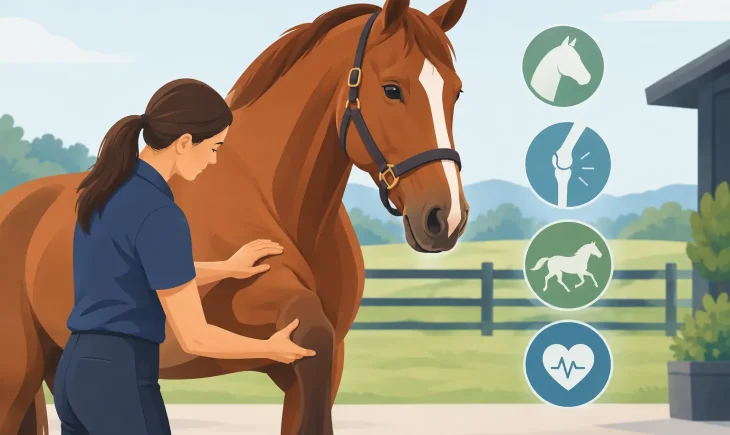
A horse that is suddenly reluctant to turn, lands unevenly after a fence, pins its ears during grooming, or loses its usual forward feel is communicating something useful. Horse pain management is not simply about making that horse more comfortable for the next ride. It starts with identifying what has changed, protecting the horse from further injury, and matching recovery support to the real cause of discomfort.
For performance horses, the temptation is to focus on the visible problem: a short stride, a stiff back, a sore-looking leg. But pain can be referred, intermittent, or tied to workload, footing, tack, dental issues, ulcers, hoof balance, and systemic illness. Fast action matters, but the right action matters more.
Start With the Cause, Not the Product
Pain is a clinical sign, not a diagnosis. A horse with heat and swelling in one leg needs a different plan than a horse that is stiff only when first leaving the stall. A horse that resists the girth may have a back issue, gastric discomfort, poor saddle fit, or behavior that has been mistaken for attitude.
Before changing training or adding a pain-relief product, document what you see. Note when the problem began, whether it improves with warm-up, where swelling or heat is present, and whether appetite, manure, hydration, or behavior has changed. Short videos of the horse walking and trotting on a straight line can help a veterinarian compare gait changes over time.
Do not ride through obvious lameness, acute swelling, severe sensitivity, or a sudden performance drop. Continuing to load a painful structure can turn a manageable strain into a longer layoff. Rest does not always mean complete stall confinement, either. The correct level of controlled movement depends on the injury and should be set with veterinary guidance.
Red Flags That Need Urgent Veterinary Attention
Some pain signs should never be managed as a routine recovery issue. Seek urgent veterinary help for severe colic signs, inability to bear weight, a suspected fracture, a penetrating wound, significant eye pain, high fever, rapidly increasing leg swelling, or distress that escalates despite removing the horse from work.
A horse that is down, repeatedly rolling, sweating heavily, or has abnormal gum color needs immediate attention. Pain relief can be part of emergency care, but it must not delay examination or mask deterioration.
Where Horse Pain Management Fits in a Treatment Plan
A practical plan usually has three jobs: reduce discomfort, address the source, and prevent recurrence. Medication may help control inflammation and allow safer recovery, but it cannot correct an unbalanced hoof, an ill-fitting saddle, a training schedule with too little recovery, or a ligament injury that needs time.
For musculoskeletal discomfort, veterinary-directed care may include anti-inflammatory medication, cold therapy in the early phase, controlled exercise, farriery changes, rehabilitation work, and joint or bone-health support when appropriate. The exact combination depends on diagnosis, competition status, age, and the horse’s medical history.
Pain linked to gastric disease, respiratory illness, dental problems, skin conditions, or neurologic disease requires a different approach. This is why using a familiar product from the tack room without a current assessment can be costly. The horse may seem better briefly while the underlying condition progresses.
Anti-Inflammatory Products: Useful, but Not Casual
Non-steroidal anti-inflammatory drugs, commonly called NSAIDs, are widely used in equine practice for pain, fever, and inflammation. They can be highly useful after veterinary evaluation, especially for acute soft-tissue inflammation, orthopedic discomfort, and certain medical conditions.
The trade-off is real. NSAIDs can affect the gastrointestinal tract and kidneys, particularly in dehydrated horses, horses with ulcer risk, older horses, or horses receiving multiple medications. Combining anti-inflammatory drugs, increasing a dose because the horse still looks sore, or extending a course without professional oversight raises the risk of serious complications.
Corticosteroids may also have a place in selected inflammatory conditions, but they are not interchangeable with NSAIDs and are not a general answer for soreness. Their risks, timing, route of administration, and suitability can vary substantially. Competition regulations may also apply to both anti-inflammatory and corticosteroid products, including withdrawal guidance that differs by jurisdiction and discipline.
For any medicine, verify the active ingredient, concentration, route, storage requirements, expiration date, and the horse’s current medication list. Keep a written treatment record. This protects the horse and gives the veterinarian a clear picture if the case changes.
Recovery Support Is More Than Medication
The most effective pain-management programs are often decided in the hours outside the treatment window. A horse recovering from soreness needs a workload that matches its tissues, not just its attitude. Many athletic horses will continue to try hard long after they should have been backed off.
Start with the basics: adequate forage, clean water, consistent turnout or prescribed controlled movement, and a stable footing plan. Check daily for heat, digital pulse changes, filling, cuts, and altered stance. For horses in regular training, build recovery days into the program instead of waiting for a problem to force time off.
Hoof care deserves particular attention. A small imbalance can change loading through the limb and worsen discomfort elsewhere. Likewise, saddle fit should be reviewed when a horse’s topline, body condition, training level, or behavior changes. A saddle that fit six months ago may no longer fit a horse returning from a layoff or developing muscle asymmetry.
Nutritional and joint-support products can support a broader conditioning program, but they should not be marketed to yourself as instant pain relief. Some horses benefit from targeted support for joints, muscles, electrolytes, or recovery needs. Results depend on the ingredient, the actual condition, daily management, and whether the horse is receiving an appropriate training load.
Monitor Response Without Masking the Problem
A useful rule is simple: comfort should improve alongside function, not replace it. If a horse looks better after treatment but becomes sore again as soon as work resumes, the workload or diagnosis needs another look.
Use objective checks where possible. Compare stride length, willingness to turn, behavior during grooming and tacking, limb temperature, appetite, and recovery after exercise. Keep notes rather than relying on memory, especially when more than one person handles the horse.
Be cautious with products that promise to keep a horse going at all costs. A calmer or more comfortable horse is not necessarily a sound horse. Pain suppression can create a false sense of readiness and encourage a return to work before healing is adequate.
Sourcing Medication Responsibly
For stable managers and owners buying equine health products online, product quality and supply reliability matter as much as price. Check that the item is clearly labeled, stored correctly during transport, and appropriate for your horse’s condition and location. Imported medications can carry additional legal, regulatory, and competition-related considerations.
Equine MedCare provides access to a broad selection of equine medications and recovery-support products for experienced horse owners and handlers. Before ordering, confirm the active ingredient and formulation with your veterinarian, particularly if the horse is competing, has a history of ulcers or kidney concerns, is pregnant, or is already receiving treatment.
Good horse pain management is not measured by how quickly a horse returns to the ring, track, or trail. It is measured by a return that holds up: a horse moving freely, eating normally, training willingly, and staying sound enough to do its job again tomorrow.