
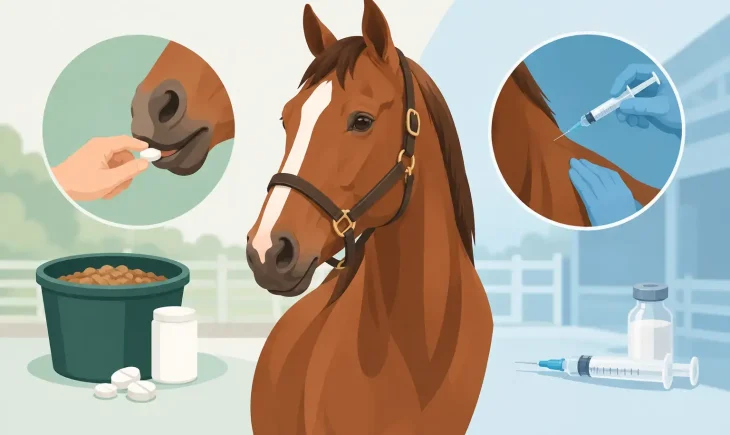
A horse that will not eat its medicated feed, a respiratory flare before a major event, or a painful joint that needs prompt attention can make route of administration a practical decision fast. When comparing oral versus injectable horse medications, the best option is rarely about convenience alone. The right choice depends on the active ingredient, the condition being managed, how quickly treatment is needed, the horse’s temperament, and the skill required to administer the product safely.
For owners, trainers, and stable managers, the goal is simple: deliver the intended treatment reliably while protecting the horse, the handler, and the horse’s competition eligibility. Oral products and injectables both have a place in a serious horse-health program, but they solve different problems.
Oral Versus Injectable Horse Medications: The Core Difference
Oral medications enter through the digestive system, usually as a paste, liquid, powder, pellet, tablet, or medicated feed. Dewormers, many supplements, joint-support products, electrolytes, gastric-support formulas, and certain anti-inflammatory or respiratory medications may be supplied this way. They are familiar to most horse people and can be practical for routine, longer-term support.
Injectable medications are delivered into the body by a specific route, commonly intravenous, intramuscular, or subcutaneous, depending on the product label and veterinary direction. This route is often selected when a medication must act predictably, when a horse cannot take a product orally, or when gastrointestinal absorption could be too slow or inconsistent.
Neither route is automatically stronger or safer. An injectable is not simply an “upgraded” oral medication, and an oral product is not always the gentler choice. The active ingredient, formulation, dose, and clinical situation determine the result.
When Oral Medication Makes Sense
Oral products are usually the more workable choice for routine management. If a horse needs ongoing nutritional support, a scheduled deworming product, or a medication that is designed for daily administration, an oral formulation can reduce handling stress and make the program easier to maintain across a busy barn.
The major advantage is practicality. A paste can be administered with a dosing syringe, while powders and pellets may fit into a feed routine when the horse reliably consumes the full amount. This matters for large operations managing several horses, especially where a treatment plan lasts weeks rather than one day.
Oral administration also avoids injection-site complications. Poor injection technique can lead to soreness, swelling, abscesses, muscle damage, or more serious reactions. For medications available in an effective oral form, avoiding unnecessary needles can be a sensible choice.
There are limits. A horse with poor appetite, colic signs, severe pain, dysphagia, or a tendency to spit out paste may not receive a complete dose. Mixing medication into grain can be unreliable if the horse leaves feed behind or another horse gains access. Some active ingredients also have variable absorption through the gastrointestinal tract, which can make timing and response less predictable.
For oral medication to work as intended, use an accurate body-weight estimate, measure each dose carefully, and confirm the horse has actually consumed it. Do not crush, split, or mix products unless the label or prescribing veterinarian confirms that it is appropriate.
When Injectable Treatment Is the Better Tool
Injectables are often used when speed, dependable delivery, or precise control matters. A veterinarian may select an injection for acute inflammation, serious respiratory compromise, infection, severe pain, dehydration, allergic reactions, or a horse that cannot safely take medication by mouth. In these cases, bypassing the digestive tract may allow the medication to reach circulation more predictably.
This route can also be valuable when a product is poorly absorbed orally or is broken down before it can produce the desired effect. Some medications are formulated specifically for injection because their pharmacology requires it. Trying to substitute an oral product for an injectable – or the reverse – can change both effectiveness and risk.
The trade-off is that injection technique is not casual barn work. Intravenous administration in particular carries significant risk if performed incorrectly. Accidental injection into an artery, leakage outside the vein, contamination, or use of an unsuitable needle can cause severe injury. Intramuscular injections can create painful reactions or abscesses, and repeated injections in the same area can damage tissue.
Use injectable horse medications only according to the product label and veterinary instructions. If you have not been trained in the required route, restraint, needle selection, site preparation, and post-injection monitoring, have a veterinarian or qualified professional administer the treatment. A fast treatment is not a good value if a preventable complication takes the horse out of work.
Absorption, Onset, and Duration Matter More Than Route Alone
Horse owners often ask which option works faster. The honest answer is: it depends on the medication and how it is formulated. Intravenous products can have a rapid onset because they enter circulation directly. Intramuscular and subcutaneous products may absorb more gradually. Oral products generally take longer because they must move through digestion and absorption first, but some are designed to provide a useful, sustained effect.
A rapid onset is not always the goal. For long-term joint support, nutritional supplementation, parasite control, or stable daily management, consistency may matter more than speed. For an urgent clinical issue, speed may matter greatly – but the underlying cause still needs proper diagnosis.
Duration matters too. A shorter-acting product may require repeat treatment, while a longer-acting formulation can remain active for days or longer. That affects cost, handling, potential side effects, and withdrawal planning. Never assume that a product’s route tells you how long it remains detectable or biologically active.
Safety Checks for Performance and Competition Horses
For racing, showing, and other regulated competition, route selection has another layer: medication-control rules. A product can be clinically appropriate and still create a positive test if it is used too close to competition or administered outside permitted rules. Detection times and withdrawal guidance may vary by organization, jurisdiction, dose, route, horse, and testing method.
Before using an anti-inflammatory, corticosteroid, respiratory medication, recovery compound, or other performance-related product, check the rules governing your event. Keep complete records of product name, active ingredient, lot number, amount administered, route, date, time, and the person who gave it. This protects the horse and gives the trainer or owner a clear treatment history.
Watch for adverse reactions regardless of route. After oral dosing, monitor appetite, manure, behavior, and signs of gastrointestinal upset. After an injection, observe the horse for heat, pain, swelling, hives, breathing changes, depression, or unusual agitation. Contact a veterinarian promptly if the horse shows signs of a serious reaction.
Cost and Convenience: Look Beyond the Price Per Bottle
Oral products can appear less expensive because they are straightforward to store and administer. Injectables may carry a higher upfront cost due to packaging, needles, supplies, professional administration, or the need to discard unused product after a defined period. However, the lowest purchase price is not always the lowest treatment cost.
A paste that a horse refuses, a powder left at the bottom of a bucket, or an injection that causes a preventable complication all create waste. Compare products based on the treatment objective, number of required doses, realistic administration success, storage requirements, and veterinary guidance. For a high-value sport or breeding horse, reliable treatment can be more economical than repeated trial-and-error purchases.
When sourcing medication internationally, verify product strength, formulation, storage instructions, expiration date, and local import requirements before ordering. A trusted supply channel such as Equine MedCare can help experienced buyers access a broad range of equine health products, but a product listing does not replace a diagnosis or a treatment plan.
Choose the Route That Fits the Horse and the Problem
Use oral medication when the product is designed for oral use, the horse can reliably receive the full dose, and the condition supports routine management. Consider injectable treatment when a veterinarian identifies a need for faster, more predictable, or non-oral delivery. Do not choose a route just because it feels more powerful or because it is easier on a single busy day.
The best treatment plan is the one that matches the medication to the clinical need, can be administered correctly every time, and keeps the horse sound, comfortable, and eligible for the job ahead. If you are deciding between two formulations, bring the product labels and your competition schedule to your veterinarian – that short conversation can prevent a costly mistake.