
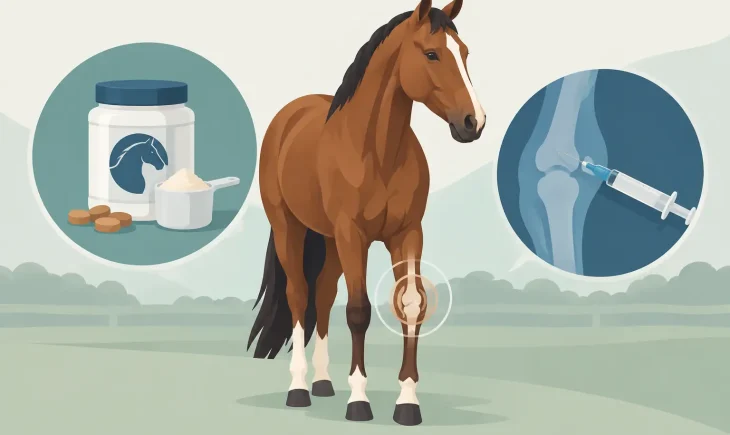
A horse that feels tight coming out of the stall, takes shorter steps after hard work, or needs longer to warm up is not asking for a random joint product. The joint supplements versus injections decision starts with one question: are you supporting a hardworking but comfortable horse, or managing a diagnosed source of pain and inflammation? Those are different jobs, and the right answer can protect both the horse’s comfort and the training budget.
For sport horses, racehorses, breeding stock, and active pleasure horses, joint care is rarely a one-product decision. Workload, age, conformation, footing, shoeing, body condition, prior injuries, and the specific joint involved all matter. Supplements can be a practical part of a daily maintenance program. Injections can be valuable when a veterinarian identifies pathology that requires targeted treatment. Using either one without a clear plan can mean spending more while missing the real problem.
Joint Supplements Versus Injections: The Core Difference
Joint supplements are generally oral products given daily or consistently over time. Their role is usually nutritional support for cartilage, synovial fluid, connective tissue, and the overall joint environment. Common ingredients include glucosamine, chondroitin sulfate, methylsulfonylmethane (MSM), hyaluronic acid, collagen, omega-3 fatty acids, and antioxidant compounds.
Injections are administered into a joint, muscle, or vein depending on the product and the veterinary treatment plan. They may include hyaluronic acid, polysulfated glycosaminoglycans, corticosteroids, biologic therapies, or other prescription treatments. Their purpose is not simply to “boost joints.” They are used to address a defined clinical concern, such as synovitis, capsulitis, osteoarthritis, or significant inflammation after a proper examination.
The practical difference is speed and precision. An oral supplement is a broad, long-term support tool. A veterinary injection can deliver a more targeted intervention, often with a faster effect when inflammation is a key driver. That does not make injections the automatic stronger option. A targeted treatment is only useful when the target is correct.
When Daily Supplements Make Sense
A well-selected oral joint supplement can be a sensible baseline for horses in regular training, older horses that remain comfortable in work, and horses with a history of mild wear-and-tear concerns. It may also suit horses moving into a more demanding season, traveling heavily, or returning to a normal conditioning program after veterinary clearance.
The benefit is consistency. Daily nutritional support is easy to build into feed routines, and it does not require a procedure each time the horse needs ongoing care. For stable managers responsible for multiple horses, this makes supplements predictable to stock, administer, and budget.
That said, not every formula delivers the same value. Look beyond a front-label claim such as “advanced joint support.” Check the active ingredients, the amount supplied per daily serving, the length of time a container lasts, and whether the horse will actually eat it. A low-cost tub is not necessarily economical if it contains underdosed ingredients or runs out in two weeks.
Supplements also require realistic expectations. Some horses appear more comfortable after several weeks of consistent use; others show little obvious change. They do not repair severe cartilage damage, correct poor hoof balance, or resolve lameness caused by a tendon injury, fracture, ulcer pain, or a back problem. If a horse is visibly lame, repeatedly stumbling, resisting collection, or deteriorating under saddle, do not mask the signs with a new powder and continue training.
When Injections May Be the Better Tool
Injections enter the conversation when there is evidence of active joint disease or clinically relevant inflammation. A veterinarian may use flexion tests, nerve or joint blocks, radiographs, ultrasound, gait evaluation, and the horse’s history to identify the source of discomfort. This diagnostic step is where the value lies. An injection placed into the wrong joint is not a shortcut to soundness.
Intra-articular treatment can be appropriate for a horse with confirmed joint inflammation that is affecting performance or comfort. Depending on the diagnosis, a veterinarian may recommend hyaluronic acid, a corticosteroid, a combination treatment, or another therapy. The selection, dose, timing, and repeat interval should reflect the individual horse, the joint involved, competition regulations, and the risks associated with the medication.
Systemic injectable products may also be part of a broader veterinary protocol. They are not interchangeable with joint injections, and they should not be treated as such. Administration route matters because it changes how a product works, what risks it carries, and what monitoring may be needed.
The major advantage of injections is that they can directly address a diagnosed inflammatory process. The trade-off is cost, procedural risk, and the need for skilled veterinary assessment. Joint injection carries a small but serious risk of infection. Steroid use requires particular judgment, especially in horses with metabolic concerns or laminitis risk. Repeated treatment without correcting workload, footing, saddle fit, shoeing, or conditioning errors can turn a useful therapy into an expensive cycle.
Cost Is More Than the Product Price
It is tempting to compare a monthly supplement cost with the price of a joint procedure and choose the cheaper number. That comparison is incomplete. A supplement is generally a recurring maintenance expense. Injections can involve examination, diagnostic imaging, sedation, sterile preparation, the product itself, and follow-up care.
However, the lowest upfront cost is not always the best value. Continuing an ineffective supplement for months while a horse works through unresolved pain can cost more in lost training, reduced performance, time off, and a worsening condition. On the other hand, scheduling injections simply because the season is starting may be unnecessary for a horse that is comfortable, sound, and responding well to sensible maintenance.
Build the budget around the horse’s actual needs. Keep records of training volume, stiffness, recovery after work, shoeing dates, changes in gait, and prior treatments. Those details give your veterinarian something more useful than “he seems a little off.” They also help reveal whether a product is genuinely helping or whether the improvement followed rest, a farrier adjustment, or a reduction in workload.
A Better Joint Care Plan Uses Both, When Needed
This is not always an either-or choice. A performance horse with diagnosed joint disease may receive veterinary treatment for a flare-up and remain on an oral joint-support program afterward. The injection addresses the immediate medical issue; the supplement supports a longer-term management routine. Neither replaces intelligent training management.
A practical program also includes conditioning that matches the horse’s fitness level, regular farrier care, appropriate warm-up and cooldown periods, stable body weight, quality forage, and recovery days. Deep or inconsistent footing can expose joint weakness quickly. So can asking a horse to perform at a level its conditioning does not support.
For horses competing under regulated rules, always check medication and withdrawal requirements before treatment. A product’s availability does not determine whether it is permitted on competition day. Keep treatment records, including product name, dose, route, administration date, and the veterinarian’s instructions. This protects the horse and avoids preventable problems at the showground or track.
Questions to Ask Before You Buy
Before choosing a joint product or arranging treatment, get specific. Is the horse actually lame, or just stiff early in work? Has the problem been localized? Is there heat, swelling, reduced range of motion, or a change in behavior under saddle? Has workload or shoeing changed recently? Are you trying to maintain a sound horse, or treat a diagnosed condition?
For supplements, ask whether the formula provides meaningful daily levels of the active ingredients and how long it should be fed before judging results. For injections, ask what diagnosis is being treated, why this product is preferred, what response is expected, what risks apply, and what management changes should accompany treatment.
The best joint-care purchase is the one that matches a clear purpose. Maintain the comfortable horse with consistent, quality support. Investigate the uncomfortable horse before asking it for more work. When the diagnosis, product, and training plan line up, you give the horse a better chance to stay useful, competitive, and comfortable for the long run.